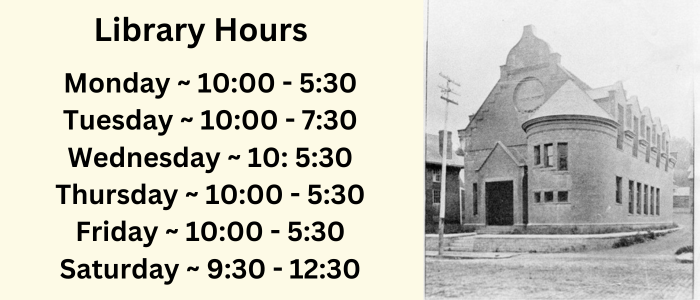
Gardiner Public Library
152 Water Street, Gardiner, Me 04345
Main Desk: 207-582-3312
Children's Room: 207-582-6894
Director: 207-582-6893

Laura E. Richards

Laura E. Richards (1850-1943), one of Gardiner, Maine's two Pulitzer Prize-winning authors, was born in Boston to eminent parents, Dr. Samuel Gridley Howe, founder of the Perkins School for the Blind; and Julia Ward Howe, social reformer and lyricist of the "Battle Hymn of the Republic." In 1871, she married Henry Richards (1848-1949), architect and industrialist, who returned to Gardiner, Maine in 1876 to manage the family paper mills. Here she wrote more than ninety works, mostly in the fields of children's literature and biography, at the family's celebrated residence, the Yellow House. Following the example of her parents, Mrs. Richards brought about social reforms and civic improvements in Gardiner including the introduction of safe drinking water, the public health nurse, the hospital, the Red Cross, a new high school, and numerous service organizations, including the Gardiner Public Library. Her permanent contribution to world literature, in the opinion of the Oxford anthology series editors, was that of nonsense verses, including perennial favorites such as "Little John Bottlejohn," "Eletelephony," and "The Poor Unfortunate Hottentot" - verses which "seemed to bubble up from some spring of nonsense" in her own words. Her first publication was a book of nonsense verses, Sketches and Scraps (1881). Other collections included In My Nursery (1890), The Hurdy-Gurdy (1902), The Piccolo (1906), and her final anthology which was in print until a decade ago, Tirra Lirra (1932). As her own children grew up, she wrote short stories which interested them. These juvenile books appeared as the Margaret Monfort series, the Hildegarde series, and others. Captain January (1890), a best seller, was twice made into movies, and the second time starred Shirley Temple. Among her adult nonfiction works were a two-volume biography of her father, Letters and Journal of Samuel Gridley Howe (1906-09); a joint biography of her parents, Two Noble Lives (1911); and, most importantly, the two-volume biography of her mother, Julia Ward Howe (1915), the first biography to be honored by the Pulitzer Prize. In her own estimation, her best works were two books of fables, The Golden Windows (1903) and The Silver Crown (1906). In her autobiography, Stepping Westward (1931) she recalls her other important work: the founding of the third boy's camp in the nation, Camp Merryweather, whose campers grew up to become national leaders and her literary mentorship of Gardiner's other Pulitzer Prize winner, Edwin Arlington Robinson (1869-1935). Pictures and a short biography of  Laura E. Richards are available at the ReadSeries.com website.
 
Back to the Gardiner Public Library Home Page Back to Special Collections
For questions or comments, please send mail to: webmaster@gpl.lib.me.us


Copyright 1997-2000 Gardiner Public Library